
We can define hair as an attribute of mammals: a cylindrical, thin filament of corneous nature that animals use to maintain body temperature and as a means of defence and camouflage.
In humans, the functions of hair are largely ornamental — though some studies link this ornamental role with sexual attraction.
Structure of the hair
Hair is divided into two basic parts: the корен и вал.
- корен is the part where high metabolic and mitotic activity takes place. It ends in the bulb, which, in a central hollow, houses the dermal papilla that carries the blood supply to the hair.
- вал is the part of the hair formed by three concentric layers of cells: the medulla, the cortex and the cuticle. Its diameter is approximately 70 to 100 microns, and its breaking load is 40 to 60 grams.
Medulla, cortex & cuticle
The central part of the hair, formed like an irregular honeycomb of cornified, rounded cells without a core and devoid of pigment. It has no influence on the physicochemical behaviour of the hair, and may be continuous, discontinuous or absent.
Cell layers extending between the cuticle and the medulla. It is responsible for the hair’s strength, elasticity, flexibility, size, shape and texture — in short, its mechanical properties.
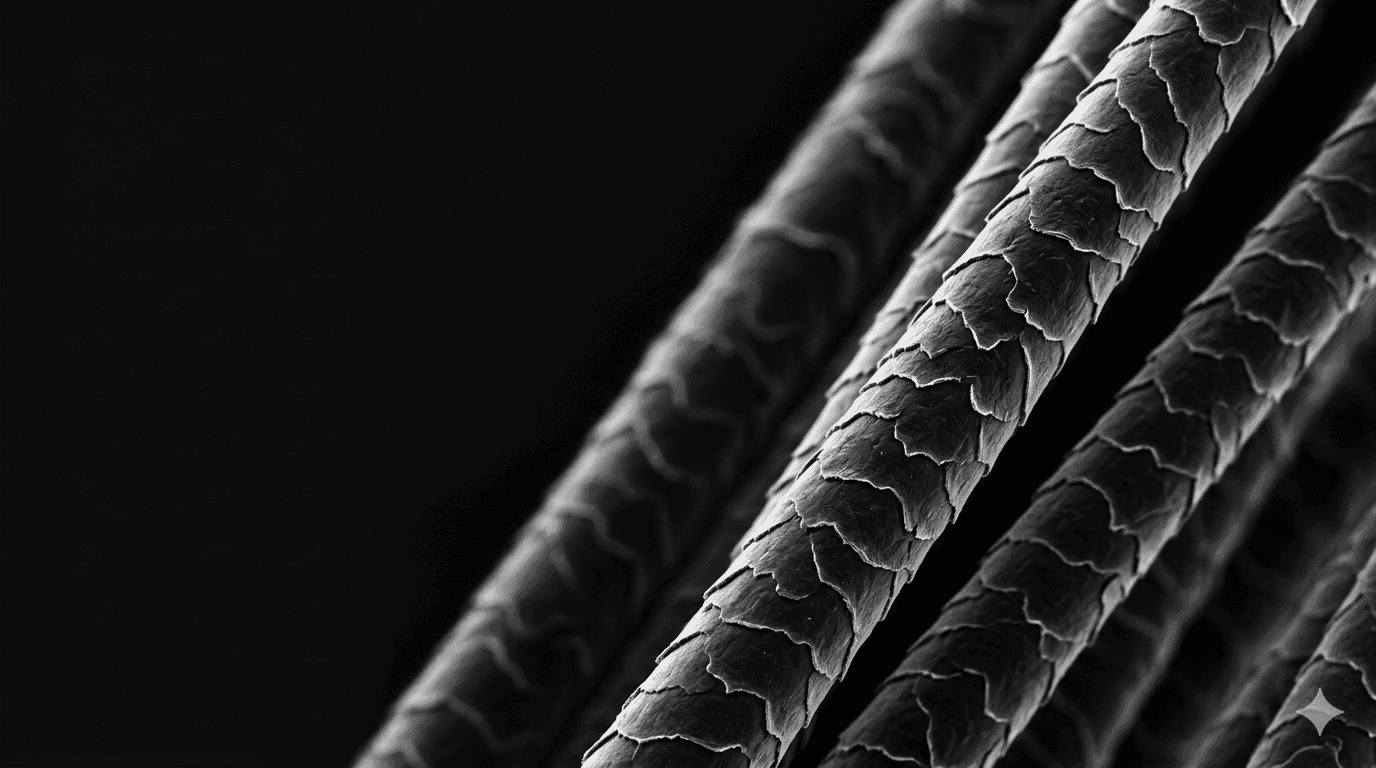
The outermost layer, made of flattened cells that overlap along the shaft like roof tiles. Transparent and resistant, it protects against chemical and physical forces. When damaged, the hair becomes porous and opaque.
Life of the hair
The life cycle of the hair begins in the bulb. The dermal papilla then produces the keratin cell layers that determine the hair.
Hair grows between one and one-and-a-half centimetres per month, and its life cycle varies from 3 to 5 years. After this, the hair is completely shed and a new germinative papilla gives rise to another new hair.
Химичен състав
Hair is composed of approximately 28% protein, 2% lipids and 70% water. The most abundant protein is keratin — a protein made of polypeptide chains rich in cysteine.
Its main elements are:
In lesser amounts it also contains calcium, copper, cadmium, mercury, zinc, lead, iron, arsenic, silicon, magnesium, uranium, vanadium, sodium and potassium.
The hair follicle
Each follicle moves through a sequence of phases, from the formation of a new hair to its eventual shedding.
Germinative phase
The primary, lowest phase: the growth of a cell into a new hair. It cannot be observed, as the process takes place before the hair has emerged from the skin.
Anagen phase
Once the hair leaves the skin it can be removed for a trichogram. Under the microscope the bulb is shaped like an elephant’s foot or an inverted fist, and appears less transparent due to very intense cellular activity.
Catagen phase
The bulb becomes irregular, its base rounds off, and its link with the papilla is minimal. The bulb moves up towards the erector muscle and growth stops. It lasts 2 to 3 weeks and is rarely observed — easily confused with anagen bulbs.
Telogen phase
The bulb is shaped like a match or almond, lacks a keratogenous area, and is about one-third the size of an anagen bulb. It accounts for around 12% of hairs in women and 14% in men. This is the phase that determines the death of the hair — approximately 3 months.