If you have ever wondered why your hair looks thinner, why your scalp gets oily or flaky, or whether your routine is actually working, a hair and scalp analysis is the best place to start. Trichology uses two complementary techniques for this: trichoscopy және trichogram.
What hair analysis means
“Hair analysis” is sometimes used for laboratory tests that measure minerals in a hair sample — that is a different procedure. In trichology and everyday hair care, it means a visual and microscopic assessment of the scalp and hair: looking closely at the scalp surface, the density of the hair, and the thickness and condition of the individual shafts.
Dermoscopy — examining skin under magnification — was first used for pigmented lesions, then extended into trichology in the 1990s. Today it is a routine, complementary tool that improves the diagnosis of different hair conditions.
Two complementary techniques
They answer different questions — one looks at the surface, the other at the root — and are often used together.
Trichoscopy
Dermoscopy applied to hair & scalp
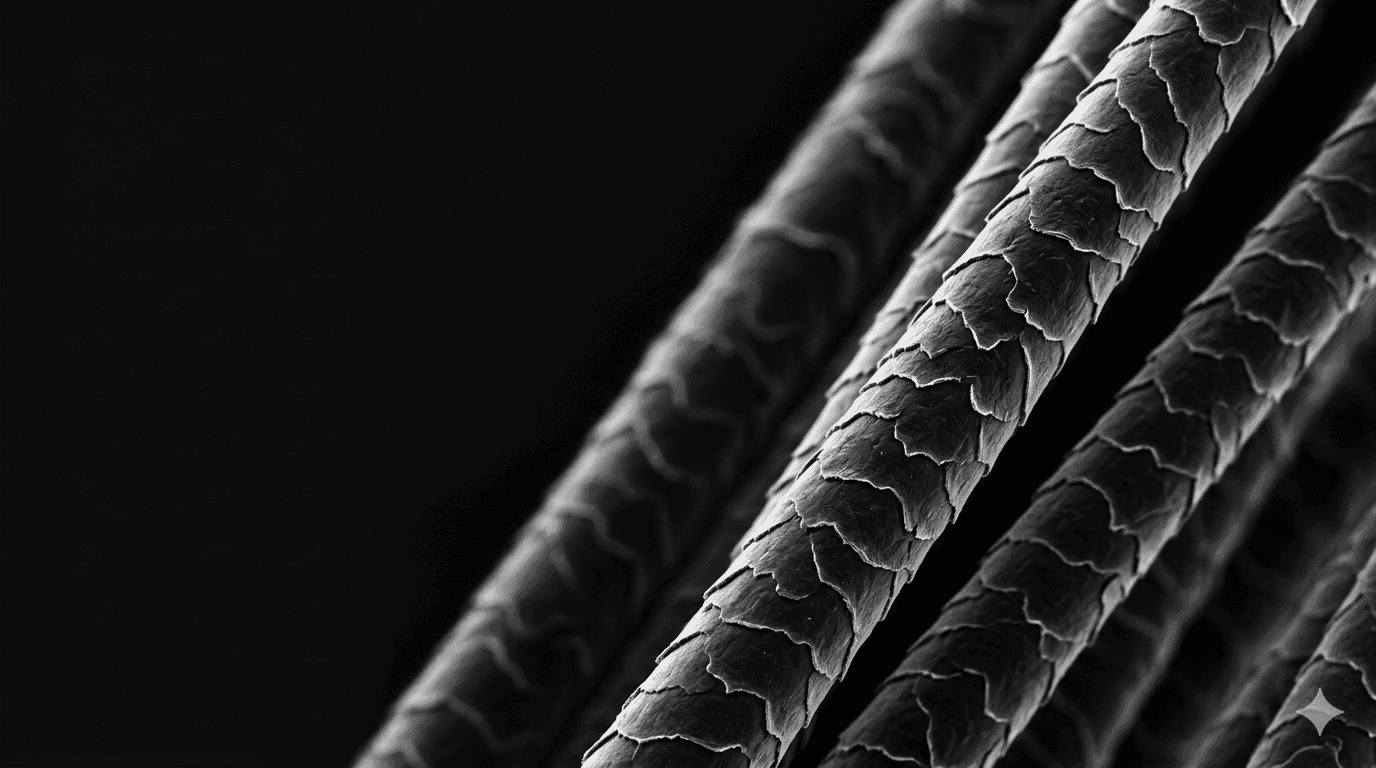
Examination of the scalp and hair under magnification with a dermatoscope — handheld or digital (videodermoscope). It shows the scalp surface, the apparent density, the thickness of the shafts and the follicular openings, with magnification from around 10× up to 20–30× (and far higher on clinical devices). Digital images can be archived to track change over time.
Non-invasive · no samples · immediateThe trichogram
Microscopic examination of plucked hairs
First described in 1964, the trichogram is a simple, rapid technique that measures hair-follicle activity. A small group of hairs is gently plucked and examined under the microscope to assess the state of the түбір (proximal end) and the кеңес (distal end), giving a snapshot of where the follicles are in their cycle.
Semi-invasive · microscopic · a snapshot in timeWhy “snapshot” matters: a trichogram reflects the follicles at the moment of sampling. Results can vary with the area sampled, recent washing or brushing, and the time of year — which is why it complements clinical evaluation rather than replacing it.
What a hair and scalp analysis reveals
Together, these techniques let a trichologist observe and evaluate:
- жағдайы scalp surface — oiliness, dryness, flaking or signs of sensitivity.
- The көрінетін тығыздық of the hair across different areas of the scalp.
- The thickness of the shafts, and whether some areas show finer, weaker-looking hair.
- The general appearance of the follicular openings and how evenly the hair is distributed.
Trichoscopy also reads the scalp’s vascular, pigmentary and follicular patterns, and can help identify genetic or acquired changes in the hair shaft. Together this builds a clear picture of the current condition of your hair and scalp — the foundation for choosing a suitable routine instead of guessing.
Conditions these techniques help guide
The main value of trichoscopy is in improving the assessment of the different forms of alopecia, and of various scalp conditions that show characteristic patterns:
Each of these shows recognisable trichoscopic signs, which is what allows a trained eye to tell them apart and to follow how they respond to a care routine over time.
Knowing your starting point matters in two moments: бұрын choosing products, so your routine matches your real concern rather than guesswork; and ішінде a routine, to follow how your hair and scalp change — which is hard to judge by eye alone. At SIMONE TRICHOLOGY, treatments are organised by concern rather than by hair type, so identifying your main concern is the first step toward the right routine.
Read our guide to hair loss & alopecia →Your first step: the free online Hair Clinic
You don’t need to book an appointment to start understanding your hair. Our тегін онлайн шаш клиникасы lets you share a few details about your scalp and hair through a simple form. A trichology specialist then reviews your case personally and sends you a personalised assessment with product recommendations by email — at no cost and with no obligation to buy.
A full trichoscopic examination with a dermatoscope is carried out in person, at professional trichology centres and clinics. The online Hair Clinic is a convenient first assessment based on the information you share — a practical way to get expert guidance and to find out whether an in-person examination would be worthwhile.
Клиникалық сілтемелер
- Trichoscopy as a non-invasive technique for evaluating hair loss; polarised-light dermatoscopy and magnification (Actas Dermo-Sifiliográficas; IntechOpen, Trichoscopy and Trichogram).
- The trichogram — first described 1964 — as a semi-invasive technique measuring follicular activity via root/tip examination; a snapshot affected by sampling and timing (Actas Dermo-Sifiliográficas; Blume-Peytavi & Orfanos).
- Trichoscopic patterns in androgenetic alopecia, alopecia areata and scarring alopecia (Rudnicka, Olszewska, Rakowska; Int J Trichology).