









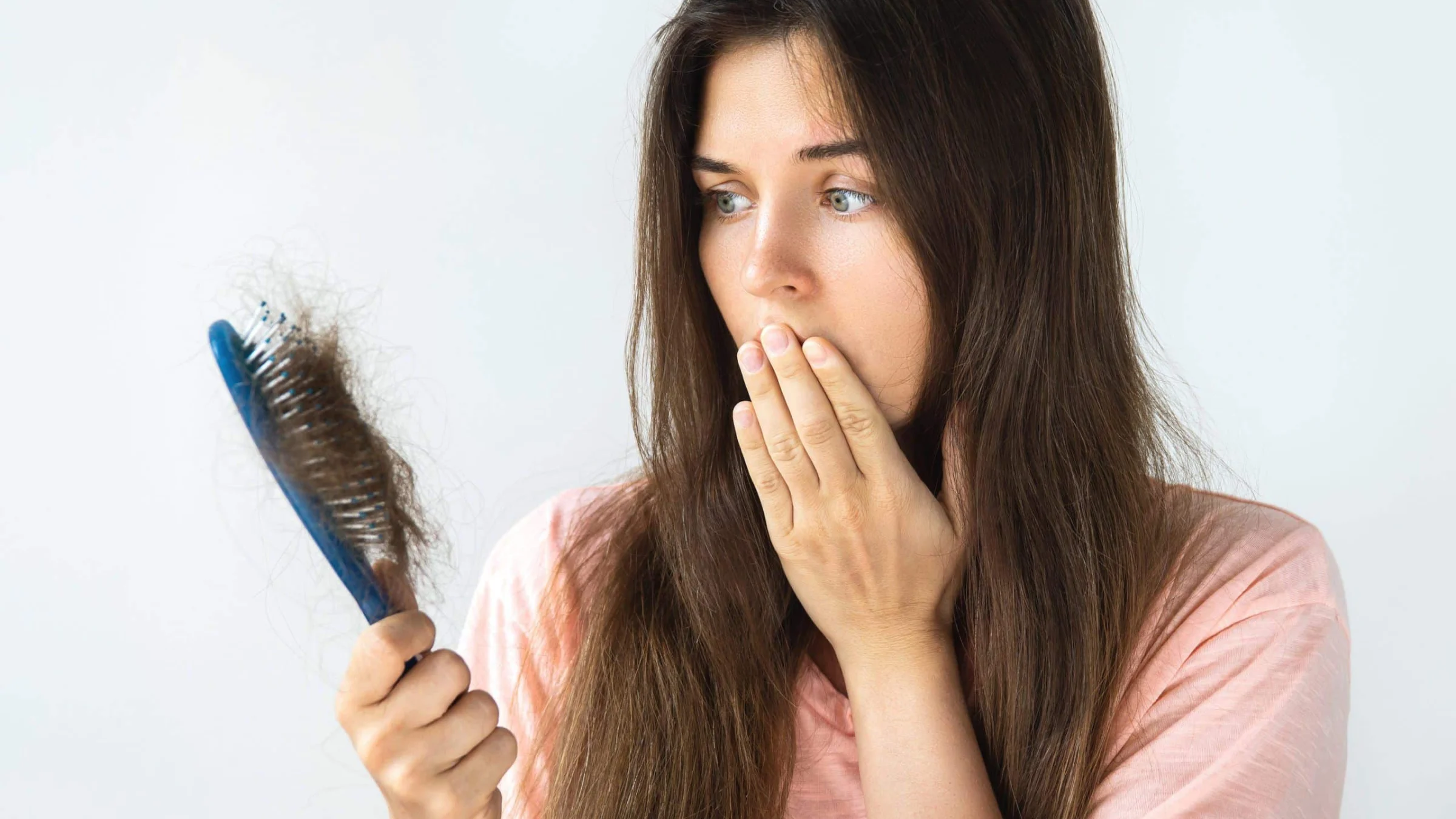
Have you noticed more hair than usual collecting in your brush or shower drain at certain times of the year? You are not imagining it. The word “alopecia” itself comes from the ancient Greek alopex, the fox — an animal that visibly sheds its coat twice a year.
Humans experience something similar, and understanding it can save you a great deal of unnecessary worry.
What seasonal hair loss actually is
Seasonal hair loss, known in trichology as seasonal telogen effluvium, is a temporary increase in shedding that occurs at predictable times of the year. It is not a disease and not a sign of permanent hair loss. It is a normal rhythm of the hair growth cycle, observed across many mammals — including humans.
To understand it, it helps to know how hair grows. Each strand moves through a cycle of three phases. Most of your hair — around 80 to 85 per cent — is in anagen, the active growth phase, which lasts between two and six years and during which the hair grows roughly one to one and a half centimetres per month. A small fraction, only about 1 to 2 per cent, is in catagen, a brief transition phase. The rest is in telogen, the shedding phase, at the end of which the hair is released and a new one begins to form in its place. With 12 to 15 per cent of your hair in telogen at any given moment, losing some hair every day is completely normal — shedding between 50 and 100 hairs a day is considered entirely typical. It is simply old hairs making way for new ones.
Why hair sheds more in spring and autumn
Seasonal shedding tends to concentrate in two windows: spring (roughly late March to May) and autumn (September to November), with the autumn peak usually the most noticeable.
The leading explanation links this to light and the body’s seasonal rhythms. Changes in daylight hours through the year appear to influence the hair growth cycle, nudging a larger share of follicles into telogen at certain times. Research has observed a higher proportion of hairs entering the telogen phase during the summer; because that phase runs its course over the following weeks, the shedding becomes visible roughly 100 days later — which is why so many people notice it in autumn rather than in summer itself.
One widely cited idea is that hair density increases slightly in summer as a natural form of scalp protection against sun exposure, and that this extra hair is shed once it is no longer needed. Whatever the precise trigger, the key point is the same: this shedding is temporary, and regrowth follows.
How much shedding is normal?
This is the question that matters most, because the answer is reassuring. With 12 to 15 per cent of your hair in the telogen phase at any time, a steady amount of daily shedding is simply the visible side of a normal cycle. During a seasonal peak, you may notice that side of the process more for a few weeks.
Seasonal shedding has two defining features: it is diffuse (spread evenly across the scalp, not concentrated in one area) and it is temporary (it settles on its own, usually within a few weeks). If your shedding fits that description, there is generally no cause for concern.
When seasonal shedding is not the explanation
Seasonal hair loss is harmless. But some patterns point to something other than a seasonal cycle, and these are worth knowing:
- A widening parting. If the gap along your parting looks progressively wider over time, that suggests genuine thinning rather than a seasonal blip.
- Loss in a defined pattern. Shedding concentrated at the temples, the hairline or the crown — rather than spread evenly — can indicate androgenetic hair loss (male or female pattern hair loss), which has a different cause and is progressive.
- Shedding that does not stop. Seasonal effluvium resolves on its own. Loss that continues well beyond the typical seasonal window, or all year round, deserves a closer look.
- Slow or absent regrowth. Seasonal shedding is followed by regrowth. If you do not see new hair coming through, that is a signal worth investigating.
If any of these describe your situation, the shedding may not be seasonal at all. In that case it is worth understanding the options for clinical hair loss and regeneration, and seeking a proper assessment rather than waiting for the season to change.
Seasonal shedding is usually mild, but if thinning persists it may have another cause. See our guide to female hair loss.
Supporting your hair through a seasonal peak
While seasonal shedding runs its course on its own, a few sensible habits help your hair through it:
- A consistent, gentle scalp and hair routine. Cleanse with products suited to your scalp, and avoid aggressive washing or excessive heat.
- A balanced diet. Hair health draws on a steady supply of nutrients; a varied diet that includes adequate protein, iron, zinc and vitamins supports the growth cycle.
- Managing stress. Significant physical or emotional stress can itself trigger telogen effluvium, separate from any seasonal effect. Building in rest and recovery genuinely helps.
When in doubt, get it assessed
The hardest part of seasonal hair loss is knowing whether what you are seeing is the normal seasonal rhythm or the early sign of something that needs attention. Often, only close observation over time — or a professional eye — can tell the difference.
If you are unsure, our free online Hair Clinic lets a trichology specialist review your case personally and send you a tailored assessment, with no cost and no obligation. It is the simplest way to replace worry with a clear answer.