


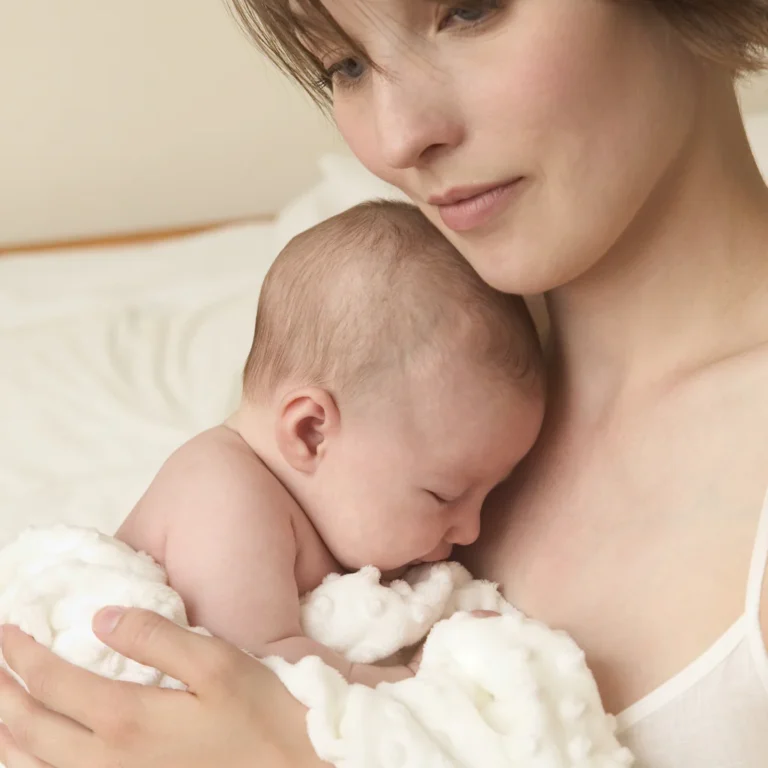
If you have recently given birth and are suddenly finding hair everywhere — on your pillow, in the shower, in your brush — you are not losing your hair permanently. What you are experiencing is one of the most common and well-understood phenomena in trichology, and in the vast majority of cases it resolves on its own. Here is what is happening, and what genuinely helps.
What postpartum hair loss is
During pregnancy, many women notice their hair looks thicker and fuller than usual. This is real, and it is hormonal. Elevated levels of estrogen during pregnancy prolong the growth phase of the hair cycle, meaning hairs that would normally have been shed stay in place. The result is denser, more lustrous hair for several months.
After birth, hormone levels return to normal. All those hairs that were “held on” during pregnancy now move into the shedding phase more or less together — and so they fall out over a relatively short period. This is known as postpartum telogen effluvium. It is not a disease, not a sign of permanent hair loss, and not something you have done wrong. It is your hair cycle re-synchronising after pregnancy.
When it happens and how long it lasts
Postpartum shedding typically begins around the fourth week after birth and can continue for several months — often around sixteen weeks — before the hair cycle settles back to its normal rhythm.
The shedding can be dramatic. Where it is normal to lose somewhere between 50 and 150 hairs a day, in the postpartum period that figure can be considerably higher for a while. Knowing in advance that this is expected — and temporary — is genuinely reassuring, because the shedding itself can be alarming when you do not know why it is happening.
Why It Can Feel Worse Than Just Hormones
While the hormonal shift is the main driver, the postpartum period brings other factors that can intensify shedding. The stress, fatigue and broken sleep that come with caring for a newborn all affect the body, and significant physical or emotional stress can itself push more hairs into the shedding phase. Nutritional demands are high too, both during pregnancy and while breastfeeding, and deficiencies — particularly of iron — can show up in the hair. None of these change the fundamental picture, but they explain why some women experience more shedding than others.
What helps
The most important thing to understand is that postpartum hair loss is self-limiting: in most cases the hair cycle recovers on its own, and the density returns. That said, a few sensible measures support your hair through the process:
- A balanced, nutrient-rich diet. Your body is recovering and, if you are breastfeeding, supporting your baby too. A varied diet with adequate protein, iron, zinc and vitamins supports the hair cycle. If you suspect an iron deficiency, it is worth raising with your doctor.
- Gentle hair care. Avoid tight hairstyles that pull at the roots, harsh chemical treatments and excessive heat while your hair is in this more fragile phase.
- Managing stress where you can. Easier said than done with a newborn, but rest and support genuinely matter — for your recovery as much as your hair.
- Patience. This is the hardest one, but the cycle needs time to re-synchronise.
When to seek a professional opinion
Postpartum shedding should ease and reverse within several months. It is worth seeking a professional assessment if the shedding continues well beyond the typical window, if you notice your hair is not growing back or is thinning in a defined pattern rather than diffusely, or if you have other symptoms — persistent fatigue, for example — that might point to an underlying issue such as a thyroid imbalance or iron deficiency, both of which are common after pregnancy and both of which are treatable.
If you are unsure whether what you are experiencing is normal postpartum shedding or something that needs attention, our free online Hair Clinic lets a trichology specialist review your case personally and send you a tailored assessment, with no cost and no obligation.
Postpartum shedding is one of the most common forms of female hair loss — see how it fits alongside the other causes.
Frequently asked questions
Yes. Postpartum shedding is extremely common and is a normal part of the hair cycle re-synchronising after the hormonal changes of pregnancy.
It typically begins around the fourth week after birth, sometimes a little later.
In most cases it eases within several months — often around four months — as the hair cycle returns to normal.
In the great majority of cases, yes. Postpartum telogen effluvium is temporary and the density usually returns as the cycle recovers.
Some women do experience thinning during pregnancy rather than after, which can be linked to nutritional deficiencies (such as iron), stress, or underlying conditions like hypothyroidism. If this is happening, it is worth discussing with a professional.
If shedding continues well beyond the normal window, if regrowth does not appear, or if it comes with other symptoms like persistent fatigue, seek a professional assessment.
