






It’s one of the most common hair questions there is — and one of the most confusing. Some people swear by washing every day; others insist that’s ruining your hair. So what’s actually true?
The honest answer: there is no single correct number. How often you should wash your hair depends almost entirely on one thing — your scalp. Let’s clear up the myths first, then work out what’s right for you.
First, three myths worth dropping
Myth 1: “Washing every day damages your hair.” Washing itself doesn’t damage hair. What can dry it out is using the wrong product, water that’s too hot, or aggressive rubbing. With a gentle, well-matched shampoo, frequent washing is fine for many people — particularly those with oily scalps.
Myth 2: “If you wash less, your scalp ‘retrains’ and produces less oil.” This is a popular idea with very little behind it. Your scalp’s oil production is driven mainly by hormones and genetics, not by how often you wash. Going without washing doesn’t reset your sebaceous glands — it just lets oil and flakes build up in the meantime.
Myth 3: “There’s one ideal routine for everyone.” There isn’t. A fine, oily scalp and a dry, sensitive one have almost opposite needs. The right frequency is the one that keeps your scalp comfortable and clean.

What actually decides your washing frequency
Rather than a fixed rule, think of washing frequency as a response to your scalp’s behaviour. The main factors are how much oil your scalp produces, whether you have flaking or sensitivity, your hair type and length, and how active your lifestyle is. Of these, the single biggest factor is your scalp type.
How often to wash, by scalp type
Oily scalp
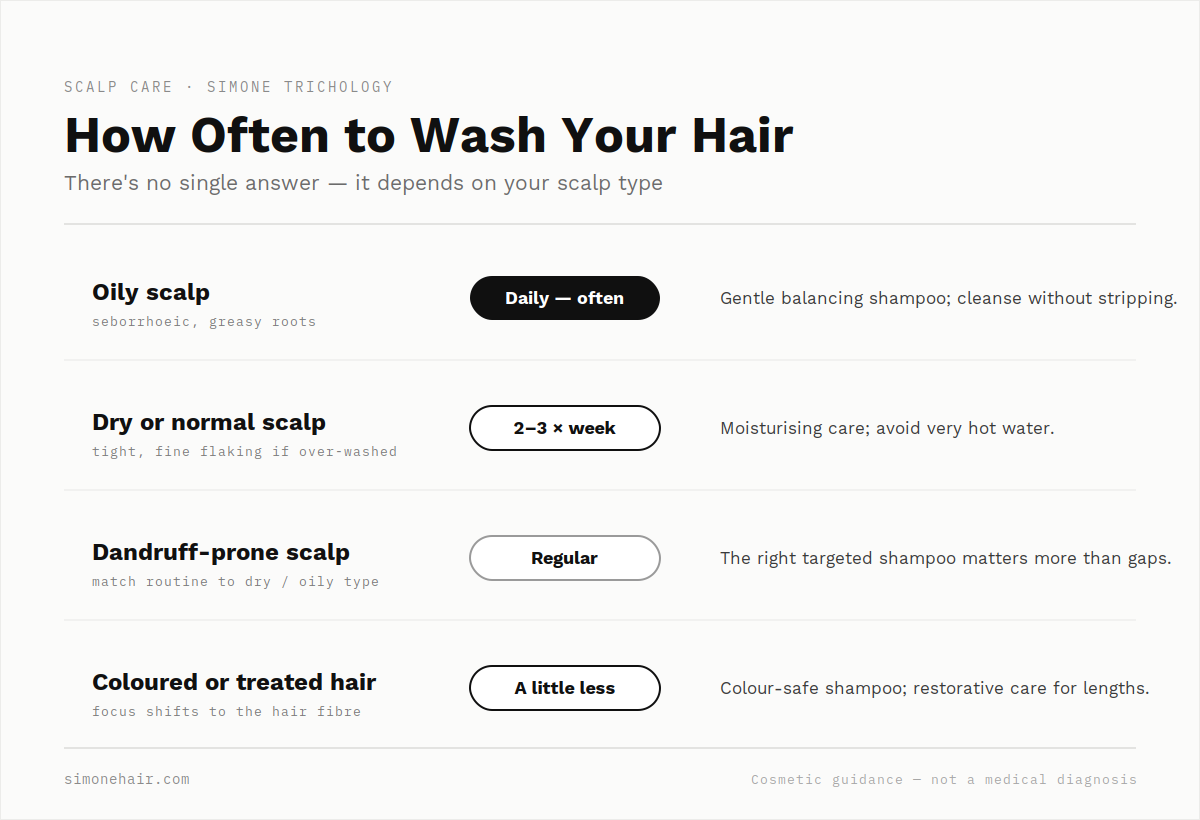
If your roots look greasy a day after washing, you have an oily — or seborrhoeic — scalp. This type usually does best with frequent washing, even daily, using a gentle, balancing shampoo designed for oily scalps. Skipping washes here tends to make the scalp feel heavier and can worsen flaking. The key is a formula that cleanses without stripping, so the scalp doesn’t overcompensate. To understand where excess sebum comes from in the first place, see our trichology guide to seborrhea and sebaceous processes.
Dry or normal scalp
A drier scalp doesn’t need washing as often — typically two to three times a week is enough to stay clean and comfortable. Over-washing a dry scalp can leave it tight and prone to fine flaking.
Between washes, focus on gentle, moisturising care and avoid very hot water.
Scalp with dandruff
If you have flaking, frequency matters less than what you wash with. Both dry and oily dandruff respond best to a routine matched to the type — see our guide on dry vs oily dandruff to work out which you have. As a rule, dandruff-prone scalps benefit from regular, consistent washing with the right targeted shampoo rather than long gaps between washes.
Sensitive scalp
A sensitive or reactive scalp calls for gentleness above all: mild, fragrance-considered formulas, lukewarm water, and no vigorous scrubbing. Frequency is less important than being kind to the scalp each time.
Coloured or chemically treated hair
Here the priority shifts from the scalp to the hair fibre. Coloured and bleached hair tends to be more porous and fragile, so washing a little less often — with a colour-safe, gentle shampoo — helps preserve colour and condition. When you do wash, follow with restorative care for the lengths.
Signs you might be washing wrong
Whatever your routine, a few signs suggest it’s worth adjusting:
- Your scalp feels tight, itchy or flaky soon after washing → you may be over-washing or using too harsh a product.
- Your roots are greasy within a day and washing less only makes it worse → an oily scalp that needs more frequent, balancing care.
- Flaking that doesn’t settle whatever you do → time to identify whether it’s dry or oily, and match the routine.
- Persistent itch, redness or discomfort → worth having your scalp looked at properly.
Not sure what your scalp needs?
The simplest way to settle the “how often” question is to know your scalp type. If you’re not sure whether yours is oily, dry, sensitive or prone to dandruff, our specialists can help. Our online Hair Clinic offers a free, no-commitment pre-assessment: a few targeted questions about your hair and scalp, and personalised guidance on the routine — and washing frequency — that suits you.
Washing is one part of looking after your scalp. See the full picture in our guide to scalp health.
SIMONE TRICHOLOGY products are dermocosmetic products and are not intended to diagnose, treat, cure or prevent any medical condition. If you have a persistent or severe scalp condition, please consult a healthcare professional.