





As a trichologist, I find the most useful way to understand this technology is not as a replacement for professional judgement, but as an extension of it. Here is how it works, what it reads, and — just as importantly — what it cannot do.
What AI scalp analysis actually is
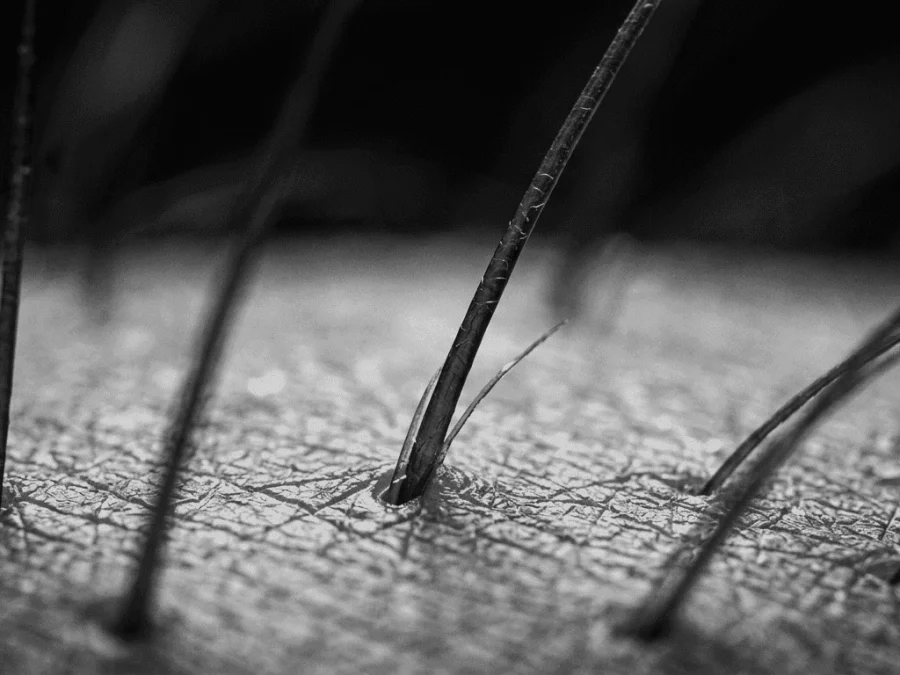
AI scalp analysis is the combination of two things: a digital trichoscopy capture and an algorithmic reading of that capture. The first part is classical — a magnified image of the scalp surface, the follicular openings and the hair shafts, of the kind trichologists have examined for decades through trichogram and trichoscopy techniques. The second part is new: instead of relying solely on the examiner’s eye, trained algorithms count, measure and compare what appears in the image.
The result is a set of objective parameters — density, calibre, coverage, surface condition — delivered in seconds rather than estimated by impression.
From capture to report: how it works
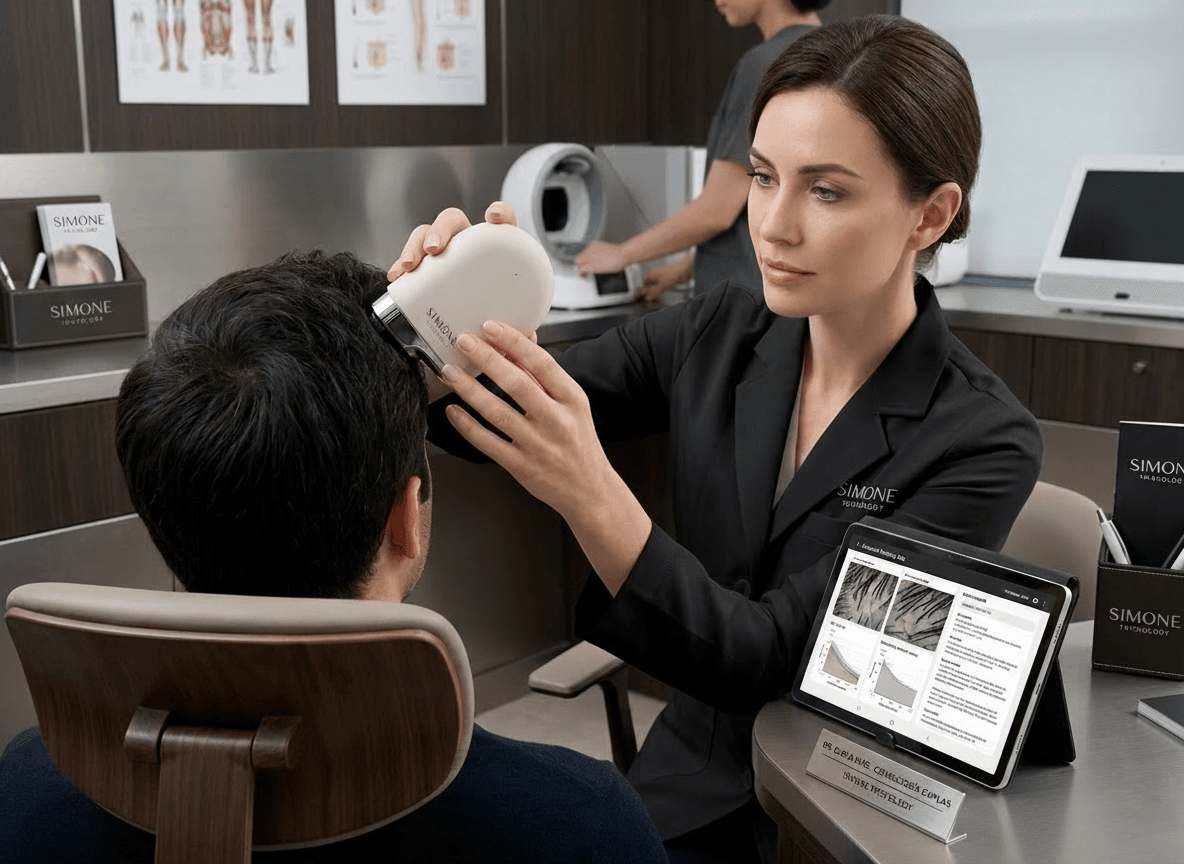
A typical session follows four steps. First, the scalp is scanned with a handheld digital device at high optical magnification — professional systems work at around 80×, under both white light and UV-A. Second, the algorithms analyse the capture, identifying individual follicles and shafts and measuring them against reference ranges. Third, the system generates a visual report the client can actually understand. Fourth, the professional interprets that report in context — history, habits, expectations — and turns it into guidance.
That last step matters. The algorithm measures; the professional interprets. A number without context is data, not advice.
AI Scalp Analysis · Simone Trichology
What a single AI capture reads.
Parameters measured, mapped and scored in seconds — to support professional judgement, not replace it.
Follicle density
Hairs mapped per square centimetre, follicle by follicle, from a single magnified capture.
Fibre calibre & volume
The thickness and body of each shaft — an early, measurable sign of how the fibre is changing.
Sebum & moisture
The oil–hydration balance of the scalp surface, read objectively instead of by touch.
Sensitivity & redness
Visual signs at 80× magnification that the naked eye simply cannot resolve.
Dandruff & pore condition
Flaking pattern and the state of the follicular openings, archived to track change over time.
Scalp health score
One /100 benchmark that turns the whole reading into a single number you can follow scan after scan.
What the algorithms read
A single magnified capture contains far more measurable information than most people expect. The core parameters include follicle density (hairs per square centimetre), the number of hairs emerging per follicle, fibre thickness and volume, sebum and moisture balance, visible sensitivity and redness, dandruff pattern and the condition of the follicular openings. Systems then combine these readings into summary indicators — a scalp health score, a hair-loss index, a scalp type classification — that make change easy to follow from one visit to the next.
Because every capture is archived, the real power appears over time: two scans a few months apart show objectively whether the picture is stable, improving or drifting — something no memory or mirror can do reliably. It is the same principle that makes routine scalp health care measurable rather than guesswork.
What AI analysis can — and cannot — do
It is worth being precise here, because enthusiasm for new technology often outruns honesty about its limits.
What it does well: it measures consistently, it sees detail beyond the resolution of the naked eye, it removes a layer of subjectivity from the consultation, and it documents change over time. These are genuine, practical advantages.
What it does not do: it does not diagnose medical conditions, and it does not replace an in-person medical examination. AI scalp analysis is a diagnostic-support and consultation tool. When a reading shows patterns that warrant medical attention, the correct next step is always a doctor or dermatologist — the technology helps identify when that step is needed, which is itself valuable.
Who benefits from it
For professionals — trichology clinics, dermatology and aesthetic practices, salons — AI analysis turns the consultation into something measurable and repeatable, and gives clients a report they can see and keep. This is the ground our own Simone AI Hair Clinic system was built for: a turnkey scanner, tablet and AI subscription designed around SIMONE TRICHOLOGY protocols. You can read the full launch announcement of the Simone AI Hair Clinic for what is in the box and how to reserve a unit. Professionals interested in offering it can also explore becoming a distribution partner.
For clients, the benefit is simpler: decisions about your hair stop being based on impressions — yours or anyone else’s — and start being based on what your scalp actually shows.
Not sure where to start?
If you are curious about the state of your own hair and scalp but nowhere near a clinic with professional equipment, start with our free online Hair Clinic: a personal pre-assessment reviewed by a trichology specialist, with no cost and no obligation.
This article is educational content about analysis technology. It is not medical advice, and no cosmetic product or analysis system is intended to diagnose, treat, cure or prevent any medical condition.