



In short: Trichorrhexis invaginata, or “bamboo hair,” is a hair shaft defect: the fiber telescopes into itself and forms nodes where it breaks easily. The hair stays short and sparse. It is the characteristic hair sign of Netherton syndrome, a genetic disease, so diagnosis is a matter for a dermatologist and care of the fiber must be extremely gentle.
If someone has mentioned “bamboo hair,” or you know a child whose hair won’t grow, breaks at the slightest friction and comes with skin problems, here we explain what trichorrhexis invaginata is, why it occurs, how it is diagnosed and how to protect such a delicate fiber.
What is trichorrhexis invaginata?
The hair shaft is a keratin structure arranged in layers: an outer cuticle of overlapping scales, a cortex that provides strength and elasticity and, in some hairs, a central medulla. When that structure forms correctly inside the follicle, the hair is flexible and stands up to everyday brushing and rubbing. You can review it in our chapter on the hair and its structure.
In trichorrhexis invaginata, keratinization of the fiber is incomplete at certain points. The affected stretch is too soft, and the harder distal segment pushes into the proximal one, like a ball-and-socket joint. Up close, the fiber shows nodes separated by normal-looking segments, which is where the name “bamboo hair” comes from. Each node is a weak point where the hair eventually snaps.
It is one of the most fragile hair shaft defects and, unlike others, it is not caused by external damage but by how the fiber itself is built.
What bamboo hair looks like
To the naked eye, hair with trichorrhexis invaginata is usually short, fine, sparse, rough to the touch and dull. It isn’t that the hair “falls out”: it simply can’t grow, because it breaks before reaching a normal length. Areas that get the most friction, such as the nape and the sides, tend to look thinner. The defect can also affect the eyebrows and eyelashes; in fact, the eyebrows are often where the nodes are easiest to identify under the microscope.
Trichorrhexis invaginata: the hair sign of Netherton syndrome
This deserves careful wording: we are talking about a disease, not a cosmetic concern. Trichorrhexis invaginata is the characteristic hair sign of Netherton syndrome, a genodermatosis, that is, a genetic skin disease. It is associated with mutations in the SPINK5 gene, which codes for a protein that regulates certain enzymes in the epidermis; when that regulation fails, both the skin barrier and hair formation are disrupted.
Inheritance is autosomal recessive: for the disease to appear, a person must receive one altered copy of the gene from each parent, and the parents are usually carriers with no symptoms. This information should be explained by a physician or a genetics service, who will assess each family’s specific situation.
Beyond fragile hair, the syndrome usually involves redness and scaling of the skin from the first months of life, a characteristic rash with scaly borders and a strong atopic tendency, with itching, eczema and allergies. How it presents varies widely from person to person. Bamboo hair has occasionally been described outside this syndrome, but in practice, finding it means that possibility must be investigated.
How it is diagnosed
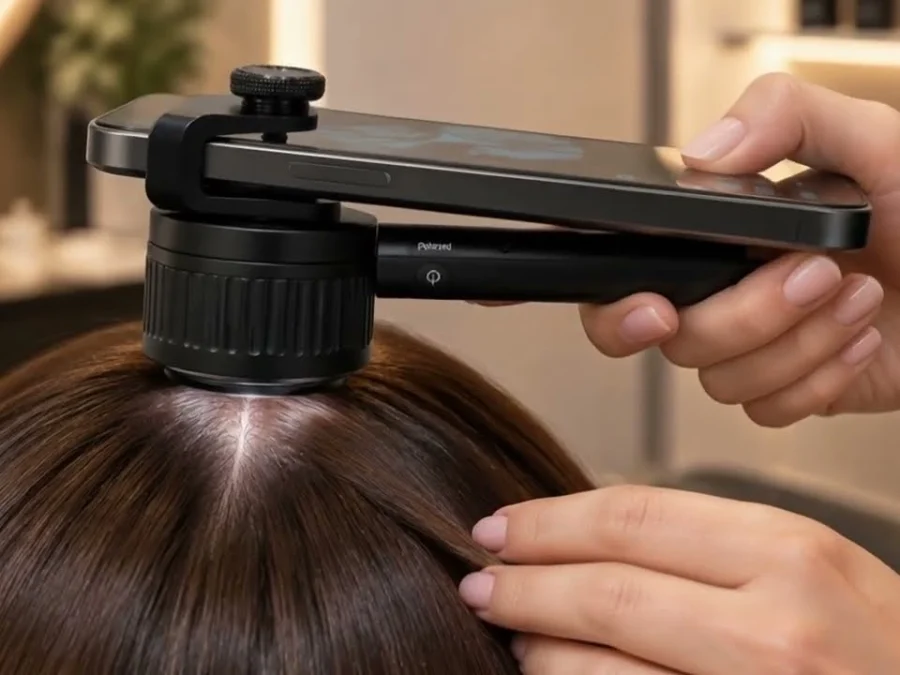
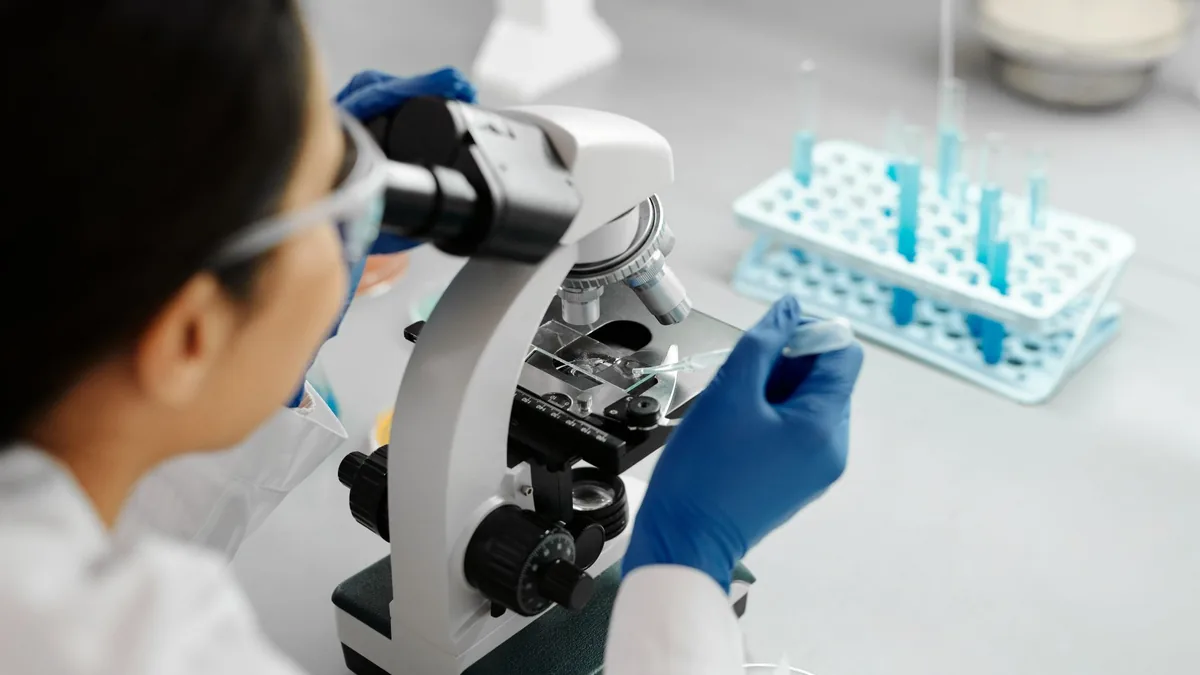
Diagnosis cannot be made with the naked eye. The dermatologist uses trichoscopy, an examination with a dermatoscope that magnifies the hair and scalp, along with light microscopy of cut or shed hairs. These reveal the invagination nodes and, frequently, broken ends shaped like a cup or a “golf tee,” which correspond to the empty proximal segment left after the node breaks.
The nodes don’t appear on every hair or along the entire fiber, so several samples sometimes need to be examined, including eyebrow hairs. And the hair study is part of a broader evaluation: the skin, family history and, if the doctor considers it appropriate, genetic testing. When bamboo hair is suspected, the right step is to see a dermatologist or pediatrician, not to change shampoo.
How to care for hair with trichorrhexis invaginata
Dermocosmetic care does not correct the defect, because the fiber is born with those weak points. What it can do is reduce whatever accelerates breakage and keep an often-sensitive scalp comfortable. We cover the factors that promote breakage in any fiber in why does hair break. Applied to this case:
- Avoid pulling and tension. No tight ponytails, tight braids, thin elastics or headbands that rub.
- Skip the heat. Flat irons, curling irons and high-heat blow-drying further weaken already fragile keratin; if you use a blow dryer, use a warm (not hot) setting, keep it at a distance and don’t pull.
- No chemical processes. Bleaching, harsh dyes, perms or straightening treatments have no place on this hair.
- Wash gently. A very mild shampoo suited to sensitive skin, lukewarm water and application with the fingertips, without rubbing the lengths.
- Detangle with care. A lightweight conditioner helps the fibers glide; do it on damp hair, with a wide-tooth comb, working from the ends up toward the roots.
- Reduce friction. Smooth-fabric pillowcases, towel-drying by pressing rather than rubbing and simple haircuts that don’t need much handling.
- Follow the medical plan. In Netherton syndrome, skin treatment is prescribed by the dermatologist; any cosmetic product must be compatible with that plan.
Can it improve with age?
Caution is warranted here. In some people, the hair fragility of Netherton syndrome becomes less pronounced over the years and the hair manages to gain some length. But this doesn’t happen in every case, the structural defect does not go away and the course is highly variable. Gentle, consistent care is the best way to protect the fiber, though no one can guarantee a specific outcome.
When to seek help, and from whom
If you notice that a baby’s or child’s hair won’t grow, breaks easily and comes with red, scaly skin or persistent eczema, see a pediatrician or dermatologist without delay. The same applies if you are an adult who has always had fragile hair, sparse eyebrows and skin problems with no clear explanation.
With the diagnosis in your doctor’s hands, if you have questions about the washing and care routine for such a delicate fiber, you can send your photos and a short questionnaire to our online Hair Clinic: a trichology specialist will offer no-obligation guidance, always as a complement to medical evaluation, never as a replacement for it.
Frequently asked questions
A hair shaft defect in which the fiber telescopes into itself, forming nodes that look like a bamboo cane. The hair breaks at those nodes and stays short and sparse. Bamboo hair is the characteristic Netherton syndrome hair sign, and finding it leads to investigating that possibility. It has occasionally been described in other contexts, but the evaluation always belongs to a dermatologist. No. Dermocosmetics do not correct the fiber defect; they can help reduce breakage from friction, pulling or heat, with gentle formulas compatible with the dermatologist’s plan. In some people the fragility eases with age, but not in every case: the course is highly variable and should be monitored by a dermatologist.What is trichorrhexis invaginata?
Is bamboo hair always caused by Netherton syndrome?
Can trichorrhexis invaginata be treated with shampoos or masks?
Does bamboo hair improve over the years?
You may also find these useful: tapered hair ends and cuticle, cortex and medulla.
This article is for general information and is not a substitute for personalized medical advice. SIMONE TRICHOLOGY products are dermocosmetic and are not intended to diagnose, treat, cure or prevent any medical condition.