





In short: female and male pattern hair loss are the same condition — androgenetic alopecia, a genetically determined sensitivity of scalp follicles to androgens — expressed in different patterns. Men typically recede at the temples and thin at the crown and are staged with the Norwood scale; women usually thin diffusely over the central scalp with the hairline preserved and are staged with the Ludwig scale.
If you are comparing a receding hairline with a widening part and wondering whether they are the same problem, this guide explains how androgenetic alopecia behaves in men and women, what the Ludwig and Norwood stages mean, how the two patterns compare point by point, and when a doctor should be involved.

One condition, two patterns: what androgenetic alopecia is
Androgenetic alopecia, also called pattern hair loss, is the most common form of progressive hair thinning in both sexes. Follicles in certain areas of the scalp are genetically programmed to be sensitive to androgens, hormones present in everyone. This hormone sensitivity gradually shortens the anagen (growth) phase and shrinks the follicle, a process known as miniaturization. Each new cycle produces a hair that is finer, shorter and less pigmented than the one before, until the follicle yields only a vellus-like, almost invisible hair.
Two points are often misunderstood. First, the condition is not caused by having “too many” hormones: most people with pattern hair loss have normal hormone levels; what differs is how their follicles respond. Second, inheritance is polygenic — it involves many genes from both sides of the family, not only the mother’s side as is often believed. For how androgenetic alopecia fits among the other types of hair loss, see our chapter on hair loss and alopecia.
The male pattern and the Norwood scale
In men, the sensitive follicles are concentrated at the temples and the vertex (crown). The typical picture is bitemporal recession — the hairline moves back at the corners, creating an M shape — combined with a thinning area at the crown that slowly enlarges. Over the years the two areas may meet, leaving a band of hair at the sides and back, where follicles are not androgen-sensitive.
This progression is staged with the Hamilton–Norwood (Norwood) scale, which runs from stage I to VII:
- Stages I–II: minimal or mild recession at the temples, often within normal adult variation.
- Stages III–IV: clear temporal recession, with or without a developing thin spot at the vertex.
- Stages V–VI: the frontal and vertex areas enlarge and the bridge of hair between them narrows or disappears.
- Stage VII: only a horseshoe-shaped band of hair at the sides and back remains.
“Type A” variants also exist, in which the hairline recedes from front to back as a single advancing line rather than through separate temple and crown areas. The scale is a descriptive tool: it helps a specialist document the current stage and follow its evolution, not predict a timeline.
The female pattern and the Ludwig scale
In women, the same miniaturization usually looks different. Instead of a receding hairline, there is diffuse thinning over the crown and the central scalp, while the frontal hairline is typically preserved. The earliest sign many women notice is a part that looks wider than before, or a ponytail that feels thinner. When the widening is most marked at the front and narrows toward the back, it is described as the “Christmas tree” pattern.
The classic staging tool is the Ludwig scale, with three grades:
- Ludwig I (mild): perceptible thinning on the crown, with the frontal hairline intact and the scalp only faintly visible.
- Ludwig II (moderate): pronounced reduction of density over the central scalp, with the part clearly widened.
- Ludwig III (severe/extensive): marked loss over the crown with the scalp easily visible, although a rim of hair at the front usually remains.
Other scales exist: the Sinclair scale grades the width of the central part from 1 to 5, and the Olsen classification highlights the frontal accentuation of the Christmas tree pattern. Whichever scale is used, complete baldness is uncommon in women; the usual course is a progressive loss of density rather than smooth bare areas.
Female vs male pattern hair loss at a glance
- Pattern: men — localized recession at the temples and thinning at the vertex; women — diffuse thinning over the central scalp and crown.
- Hairline: men — recedes early and progressively; women — usually preserved, even at advanced stages.
- Onset: men — may begin any time after puberty, often noticed in the 20s and 30s; women — often noticed later, around or after menopause, although it can begin earlier.
- Hormonal factors: both — follicle sensitivity to androgens with usually normal hormone levels; women — signs of hyperandrogenism, when present, call for a medical work-up.
- Scale used: men — Hamilton–Norwood, stages I to VII; women — Ludwig I to III, or alternatively Sinclair or Olsen.
- Typical progression: men — frontal and crown areas may merge, leaving a horseshoe band; women — gradual loss of density, with total baldness uncommon.
These are tendencies, not rules. Some women develop a male-type pattern with temporal recession, and some men show diffuse thinning over the top of the scalp with a stable hairline. A specialist stages the pattern actually present, not the one expected for the patient’s sex.
Hormones: what is different for women
The female pattern may become more noticeable at hormonally sensitive moments — after pregnancy, when changing hormonal contraception, around menopause — so women often ask whether hormones are the cause. In most cases they are not: the typical woman with androgenetic alopecia has normal hormone levels, and a shift in hormonal balance has simply unmasked a sensitivity that was already there.
The exception matters. When thinning appears alongside signs of hyperandrogenism — irregular or absent periods, persistent acne, excess facial or body hair, as seen for example in polycystic ovary syndrome — a doctor should order a hormonal evaluation, since managing the underlying condition is part of the plan. Our article on the causes of female hair loss covers these hormonal scenarios and the other reasons women lose density.
Is it really pattern hair loss? Conditions that mimic it
Not every thinning scalp is androgenetic alopecia, and several conditions can look similar or coexist with it:
- Telogen effluvium: diffuse shedding of normal-caliber hairs after a trigger such as illness, childbirth or stress; it often coexists with pattern hair loss and can make it look suddenly worse.
- Iron deficiency and thyroid disorders: both can cause diffuse loss and are checked with blood tests.
- Alopecia areata: smooth, well-defined bare patches that appear quickly rather than gradual thinning.
- Frontal fibrosing alopecia: a receding hairline in women, often with eyebrow loss, is not the usual female pattern; it is a scarring process and needs a dermatologist promptly.
For a broader tour of the types and causes of hair loss, our guide to what you should know about hair loss is a good starting point.
How a trichologist confirms the diagnosis
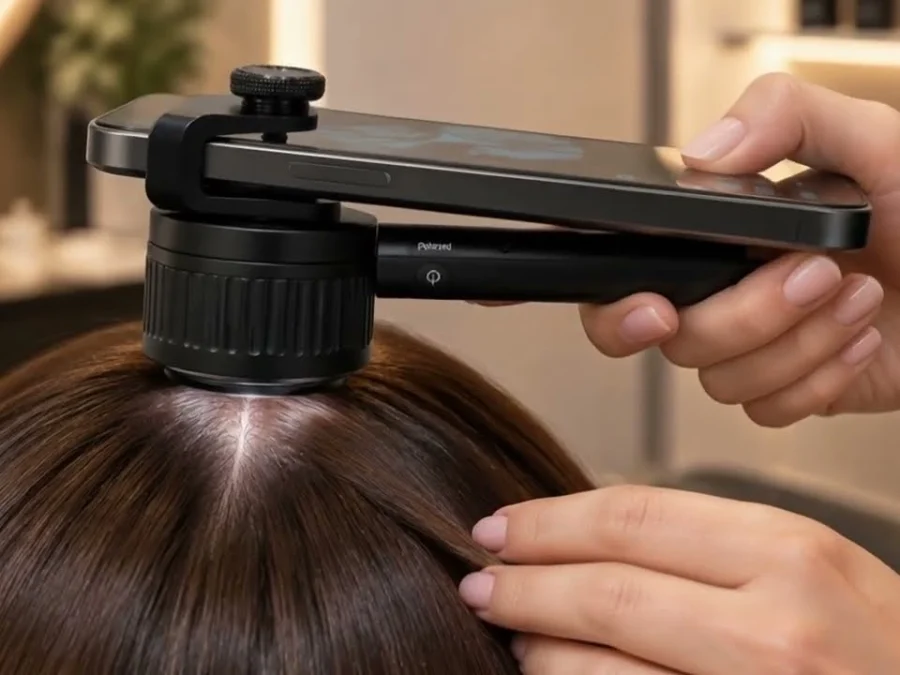
Diagnosis is primarily clinical: the distribution of the thinning, how long it has been developing and the family history usually point to androgenetic alopecia. Trichoscopy (magnified examination of the scalp) adds objective signs. The characteristic finding is hair shaft diameter variability above 20%, reflecting miniaturized hairs growing next to normal ones. Other typical features are more follicular units containing a single hair, yellow dots at empty follicular openings and a brownish perifollicular discoloration. These signs concentrate in the frontal and crown areas and are compared with the occipital region, which is usually spared.
Blood tests are ordered when the history suggests a deficiency, a thyroid problem or hyperandrogenism, or when telogen effluvium is suspected on top of the pattern. A scalp biopsy — typically a 4 mm punch — is rarely needed, mainly to rule out a scarring alopecia.
Managing pattern hair loss: what to expect
Androgenetic alopecia is chronic and progressive, so earlier evaluation matters: treatment is generally better at preserving existing hair than at recovering follicles that have already miniaturized. Treatment decisions belong to a doctor. Topical minoxidil is an approved option; oral and hormonal medications are prescription decisions that depend on sex, age and health status, since side effects and contraindications vary and some treatments are not suitable during pregnancy. Procedures such as platelet-rich plasma, low-level laser and hair transplantation exist, with evidence that varies by approach; cosmetic camouflage (fibers, concealers, styling) remains a legitimate option at any stage.
Two expectations matter. Results take months, because the hair cycle is slow — hair grows roughly 1 cm per month — and any change in density appears gradually. And because the follicles’ sensitivity does not go away, stopping treatment typically leads to the loss resuming. Dermocosmetic scalp care supports a healthy scalp environment but does not replace medical treatment. Our overview of treatment options for hair loss covers the possibilities in more detail.
Finally, the emotional side deserves acknowledgment: watching a hairline move or a part widen affects self-image in men and women alike, and that is a valid reason to seek help. If you would like a first opinion, our free online Hair Clinic lets a trichology specialist assess your photos and a short questionnaire, with no obligation.
Frequently asked questions
Yes. Both are androgenetic alopecia: a genetic sensitivity of certain scalp follicles to androgens that causes progressive miniaturization. The difference lies in the distribution — temples and crown in men, diffuse central thinning with a preserved hairline in women — and in the staging scales. The Norwood scale (stages I to VII) describes male-pattern hairline recession and vertex thinning; the Ludwig scale (I to III) grades the diffuse central thinning typical of women. Each is applied to the pattern actually present, so a woman with a male-type pattern may be staged with Norwood. In most cases, no: hormone levels are usually normal and the follicles are simply more sensitive. A hormonal work-up is advisable when thinning comes with irregular periods, acne or excess facial or body hair, which can point to a condition such as polycystic ovary syndrome. It can often be slowed and existing hair preserved with treatment chosen by a doctor, especially when started early. Improvement takes months, and because the underlying sensitivity persists, stopping treatment typically allows the thinning to resume.Is female pattern hair loss the same condition as male pattern baldness?
What is the difference between the Ludwig scale and the Norwood scale?
Do women with androgenetic alopecia have a hormone problem?
Can pattern hair loss be stopped?
This article is part of our guide to hair loss and alopecia. You may also find these useful: telogen effluvium causes and recovery and iron deficiency and hair loss.
This article is for general information and is not a substitute for personalized medical advice. SIMONE TRICHOLOGY products are dermocosmetic and are not intended to diagnose, treat, cure or prevent any medical condition.